Spine Mechanobiology
CT-based vertebral strength ↗
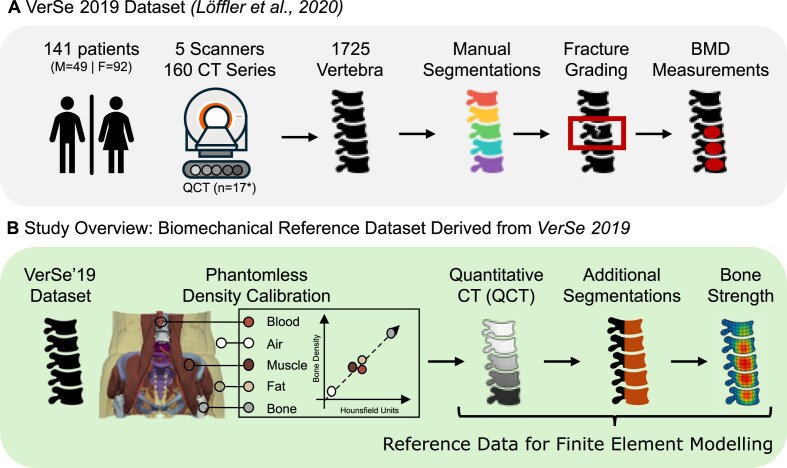
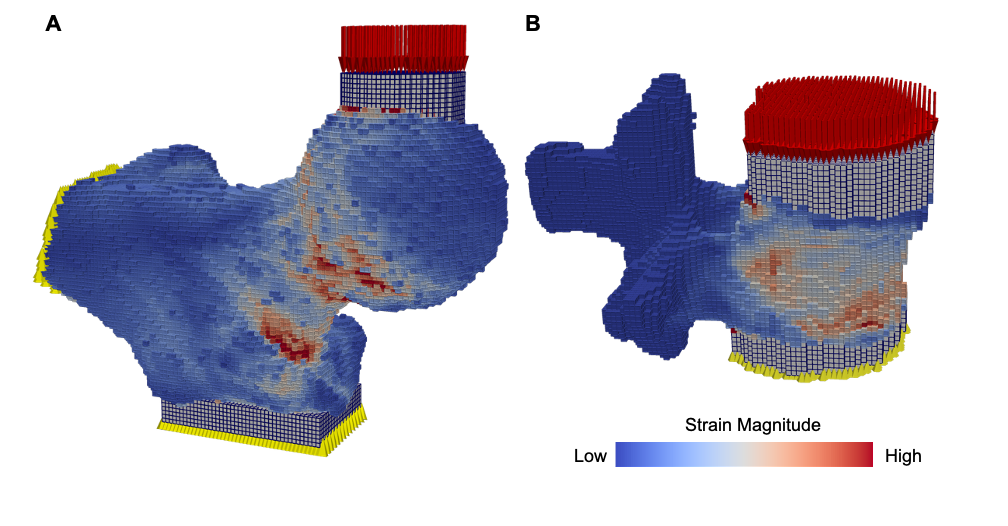
Benchmarking linear and nonlinear finite element models across the thoracolumbar spine.
Published research
RESEARCH
Studying how spinal alignment changes loading, and how those mechanical conditions relate to degeneration and tissue adaptation.
In adult spinal deformity, alignment and tissue degeneration change together. Our aim is to connect these changes through multimodal imaging and computational mechanics, rather than treating alignment as a geometric measurement alone.
We are developing a direction that combines CT, MRI, and radiographs to assess alignment and longitudinal degeneration. A further question is how reproductive and hormonal status may relate to progression and mechanical adaptation.
Our GigaScience vertebral-strength benchmark compares linear and nonlinear finite element models across the thoracolumbar spine. The quantitative CT book chapter, in Biomechanics and Mechanobiology of Bone, discusses clinical advances and technical challenges of quantitative computed tomography.
These methods support the development of imaging and mechanical analyses for spinal alignment. We are exploring Alberta's Tomorrow Project as a potential cohort for this work.
Spine Mechanobiology
Benchmarking linear and nonlinear finite element models across the thoracolumbar spine.
Spine Mechanobiology
A book chapter on quantitative CT in Biomechanics and Mechanobiology of Bone, by Walle, Matheson and Boyd.