RESEARCH
Deep learning for motion grading
Using convolutional neural networks to support motion-quality assessment in high-resolution bone imaging.
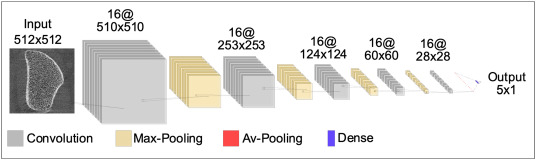
Small movements during an HR-pQCT scan can affect measurements of bone microstructure. This study develops deep convolutional neural networks to support motion grading and image-quality assessment.
The mechanobiology connection starts with reliable images: comparing local tissue change across time requires distinguishing biological differences from acquisition artefacts.
This work illustrates how machine learning can address a practical measurement problem in medical imaging.
Read the motion-grading paper or explore the MotionScoreHRpQCT code.