RESEARCH
Bone adaptation after spaceflight
Tracking bone loss and recovery in astronauts, through a Calgary-led programme with NASA collaborators.
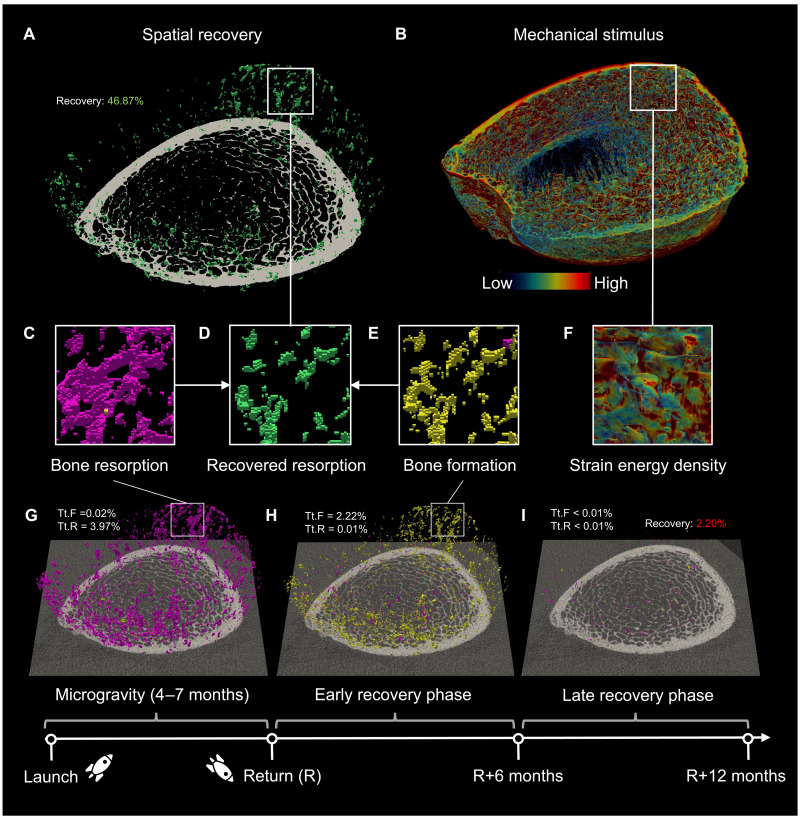
Spaceflight provides an unusual setting to study what happens when skeletal loading changes. Longitudinal HR-pQCT lets us track where bone is resorbed during missions and where it forms after astronauts return to Earth.
This study links local tissue change with finite element estimates of mechanical stimulus. It identifies a limited period in which formation targets previously resorbed sites, connecting recovery with both mechanical signals and biological coupling.
Matthias was first author of this remodelling study within the University of Calgary spaceflight bone research programme led by Steven K. Boyd, in collaboration with researchers at NASA Johnson Space Center and other institutions.
Read the Science Advances paper. Related publications examine four-year recovery and short-duration spaceflight.